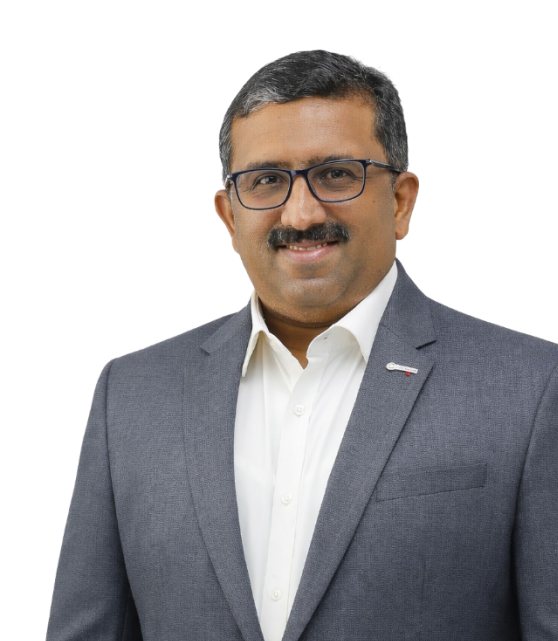
Prof (Dr) Renjith Thomas CChem, FRSC

Professor, Department of Chemistry,  Dean of Research & Development and International Relations, Director, Centre for Theoretical & Computational Chemistry (CTCC), St Berchmans College (Autonomous), Mahatma Gandhi University, Changanassery, Kerala, India. 

About

The Theoretical and Computational Chemistry Research Group at the St. Berchmans College CTCC is a dynamic hub for scientific innovation and discovery. Established in 2022, our group has rapidly built a reputation through a consistent record of high-impact publications and the successful pursuit of competitive research grants. We pride ourselves on a vibrant, inclusive culture that unites PhD scholars, postdoctoral fellows, and dedicated undergraduate and postgraduate students. By integrating visiting researchers and maintaining strong global collaborations, we foster an interdisciplinary environment where diverse expertise drives breakthroughs in the molecular sciences.
Please see the research page to know more about our research  and also the about page to know more about the Dr Renjith Thomas.

Our Publications

Cu-Schiff base complex in Polyhedron

Cu-Schiff base complex in Polyhedron

PhD student Rajimon KJ's 7th first-authored paper was published in Polyhedron (Elsevier). Structural, spectroscopic, and biological properties of an asymmetric Cu (II) Schiff-base complex: Synthesis, DNA/BSA interactions, and antimicrobial potential with experimental and computational insights

View
Collaborative paper with Prof BK Sarojini, Mangalaore University

Collaborative paper with Prof BK Sarojini, Mangalaore University

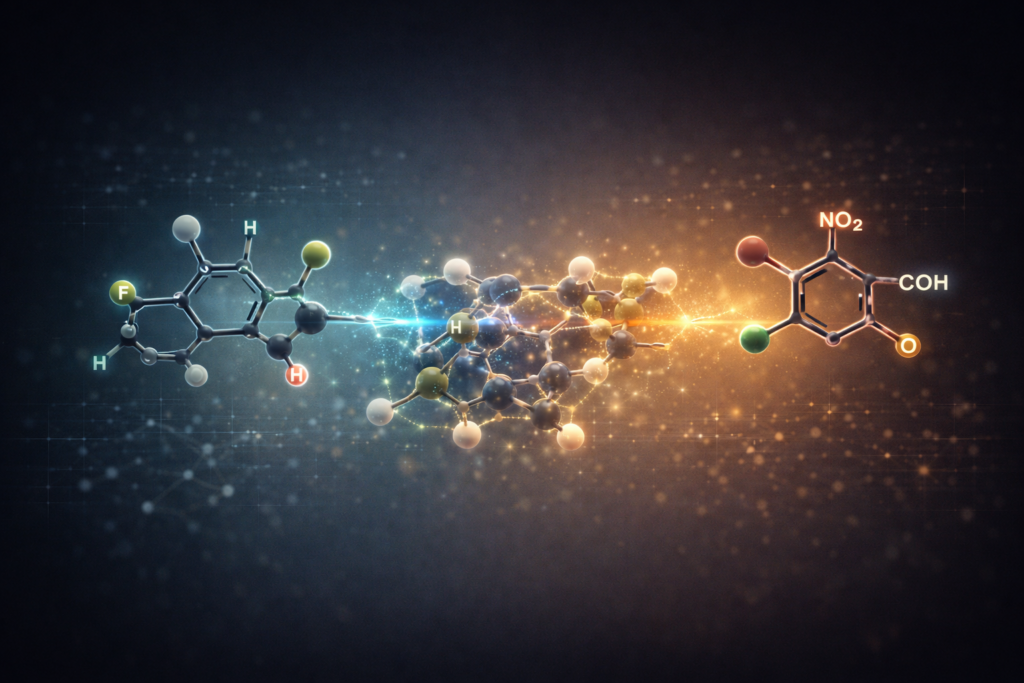
Supramolecular and computational analysis of Fluconazole −2−chloro−5−nitrobenzoic acid cocrystal. PhD student, Rajimon KJ was a visitor at her lab last year.

View

What We Do


The group has established a strong presence in the scientific community through a robust publication record and the successful acquisition of competitive research funding. It consists of a vibrant and diverse team of PhD scholars, postdoctoral researchers, and MSc students, fostering a collaborative and interdisciplinary environment for scientific inquiry and discovery.

To pioneer at the intersection of fundamental molecular theory and computational innovation, CTCC is dedicated to decoding the interesting un predicatble nature of the chemical bond. Our research focuses on the rigorous analysis of non-covalent interactions, aromaticity, and electronic structure to provide a definitive understanding of molecular behavior. By integrating traditional chemical intuition with emerging technologies in Machine Learning, Artificial Intelligence and Quantum Computing, we strive to advance the frontiers of catalysis, molecular recognition, and solvation dynamics. Our mission is to foster an interdisciplinary environment that empowers the next generation of scientists to bridge the gap between abstract theory and sustainable solutions in molecular materials science, energy science, drug discovery etc , ensuring a future grounded in molecular excellence.

Non-Covalent Interactions (NCI): Modeling and deconstructing weak interactions, specifically hydrogen bonds, sulfur-centered hydrogen bonds, and halogen bonds.
The Berchmans Protocol: Implementing the BerchNCI 1.0 systematic computational protocol for deconstructing non-covalent interactions.
Proton Sponges: Researching the electronic structure and properties of specialized organic bases.
Aromaticity: Investigating ground and excited state aromaticity, as well as dynamic aromaticity.

Solvation Dynamics: Studying how solvents like water, ethanol, and DMSO interact with bioactive molecules.
Machine Learning Integration: Applying machine learning tools to understand and predict solvation dynamics

Organic Semiconductors: Elucidating π-π interactions in for next-generation OLEDs.
Catalysis Modeling: Investigating electron-hole upconversion reactions and various catalyzed cycloaddition reactions
.Nanoscale Interactions: Studying the adsorption of drugs onto 2D/3D nanosurfaces and metal nanoclusters for enhanced Raman detection (SERS).

In Silico Modeling: Designing molecular libraries of anticancer and antimicrobial heterocycles, particularly those with imidazole and pyrazole backbones.
Drug Repurposing: Using computational tools to evaluate existing drugs for new therapeutic applications, including research on COVID-19 protein inhibition.
Photodynamic Therapy: Modeling the deexcitation dynamics of photosensitizers in solution after photo-excitation.

We are moving beyond traditional molecular modeling to lead a new era of autonomous, AI-driven discovery and quantum-enhanced simulation. Our research is strategically shifting toward the development of hybrid quantum-classical algorithms that achieve a level of precision in molecular interactions previously thought impossible. By pioneering these computational tools, we aim to design next-generation materials for CO2​ capture and explore quantum effects in biological systems to address the most pressing global challenges in energy and healthcare.
We also redefining the discovery process by transitioning from manual drug design to AI-integrated material innovation. Using our established BerchNCI 1.0 protocol as a foundation, We are building a standardized digital framework to deconstruct the complex "molecular glue" of non-covalent interactions with absolute predictive accuracy. This systematic approach allows my group to bypass traditional trial-and-error methods, accelerating the creation of smart, sustainable chemicals and life-saving pharmaceuticals.
Ultimately, our work at CTCC bridges the gap between fundamental theory and real-world impact. Through global partnerships and interdisciplinary inquiry,We arefostering an environment where quantum computing and AI serve as the primary drivers for a sustainable future. This vision ensures that our research remains at the absolute forefront of next-generation scientific discovery, turning subatomic insights into global solutions.

News & Updates

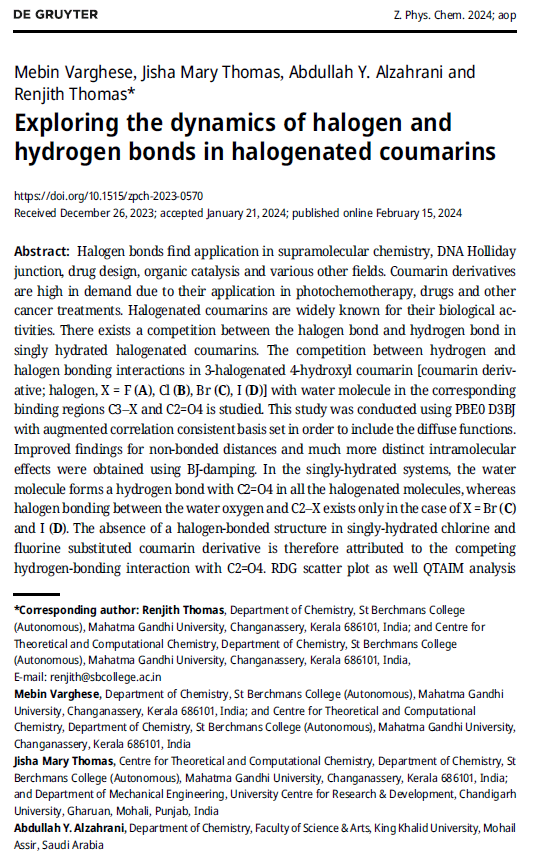
Mebin Varghese’s work ‘Exploring the dynamics of halogen and hydrogen bonds in halogenated coumarins’

Mebin Varghese’s work ‘Exploring the dynamics of halogen and hydrogen bonds in halogenated coumarins’

Mebin Varghese's theoretical study has revealed insights into the competition between halogen and hydrogen bonds in singly hydrated halogenated coumarins, crucial molecules in cancer treatment and photochemotherapy. Using advanced computational methods, researchers found that water molecules form hydrogen bonds with the coumarin derivatives, but halogen bonding is observed only with bromine and iodine substitutions. This study, employing techniques like PBE0 D3BJ with augmented correlation consistent basis set and DLPNO-CCSD(T) for local energy decomposition analysis, advances our understanding of molecular interactions significant in drug design and supramolecular chemistry. Varghese, Mebin, Thomas, Jisha Mary, Alzahrani, Abdullah Y. and Thomas, Renjith. "Exploring the dynamics of halogen and hydrogen bonds in halogenated coumarins" Zeitschrift für Physikalische Chemie

Read More
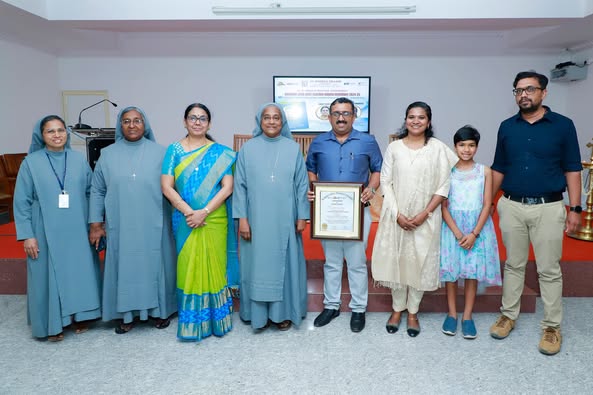
Recieving the Dr Sr Annie Kuriakose National Award for the Best College Teacher

Recieving the Dr Sr Annie Kuriakose National Award for the Best College Teacher

Honored to receive the Dr. Sr. Annie Kuriakose Endowment National Level Best Teacher Award 2024-25 at St. Joseph’s College, Irinjalakuda, from Dr. P.V. Radhadevi, Director, ADRIN, ISRO, Hyderabad, in the esteemed presence of Dr. Sr. Annie Kuriakose, Superior General of the Congregation of the Holy Family. Omnia ad Majorem Dei Gloriam. All for the Great Glory of God.
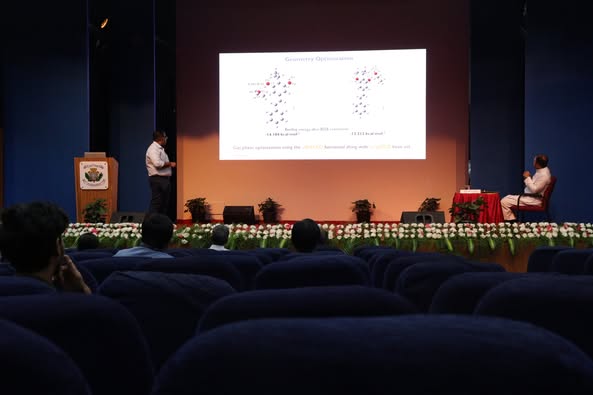
Invited Lecture at St Josephs University Bangalore, National Conference.
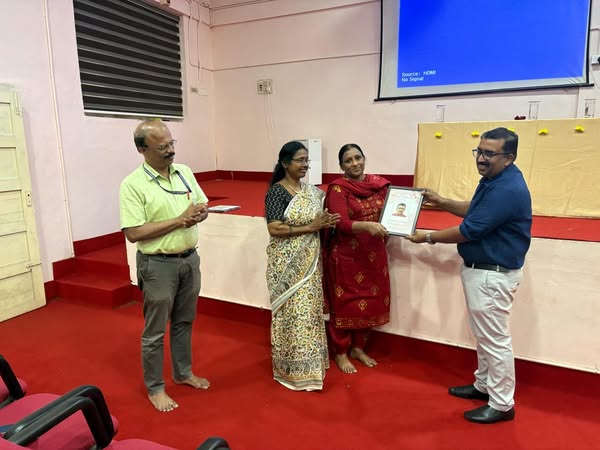
Invited Lecture at St Josephs University Bangalore, National Conference.

National Science Day celebrations at Mahatma Gandhi Univeristy

National Science Day celebrations at Mahatma Gandhi Univeristy

Honoured to deliver an invited lecture as part of the National Science Day 2025 celebrations, jointly organized by Mahatma Gandhi University and the Kerala Academy of Sciences at the School of Biosciences Auditorium. The event was inaugurated by Hon. Vice-Chancellor Prof. C.T. Aravind Kumar, in the esteemed presence of Prof. Jayachandran K, Dean of Research, and Prof. Linu Mathew, Director of the School of Biosciences.

Get In Touch

We welcome research collaborations and enquiries from theoreticians, experimental chemists, and interdisciplinary researchers. Prospective PhD, postdoctoral, and student researchers are encouraged to contact us via the details below or the message form.

Prof. (Dr.) Renjith Thomas
FRSC
Department of Chemistry

St. Berchmans College (Autonomous)

Changanassery, Kerala, India – 686101
https://faculty.sbcollege.ac.in/profile/renjith.thomas.frsc
www.thertlab.org

[email protected]
[email protected]

+91 95446 58314